Quick Information
RECOMMENDED DURATION
1 hour
Timings
09:00–17:00
TICKETS
From $25.74
NUMBER OF ENTRANCES
2
EXPECTED WAIT TIME - STANDARD
0-30 mins (Peak), 0-30 mins (Off Peak)
Did you know?
The popular name “Matthias Church” refers to King Matthias Corvinus, whose coat of arms appears on the tower.
Official church tickets can be used during the selected calendar year rather than only on one specific day.
The official audio guide currently lists Hungarian, English, Italian, and Polish.
Book Matthias Church tickets & tours
Matthias Church Entry Tickets

Is Matthias Church worth visiting?
You step in from Holy Trinity Square and the mood changes fast. Outside, there are cameras, tour groups, and wide Castle District views. Inside, the light softens across painted walls, patterned columns, and stained glass, and the church feels less like a vast cathedral and more like a jewel box.
It was built as Buda’s Church of Our Lady and became a royal and coronation church, which is why the space carries more ceremony than its size suggests. What you see today is also shaped by a 19th-century Gothic Revival restoration that turned history into color, pattern, and surface.
The payoff is texture. You leave remembering not one grand object, but the feeling of standing inside a room where Hungarian state history and Catholic ritual once shared the same stage.
Skip it if you only want free viewpoints and have no interest in church interiors as the square outside already gives you the Castle District setting.
What to see inside Matthias Church?
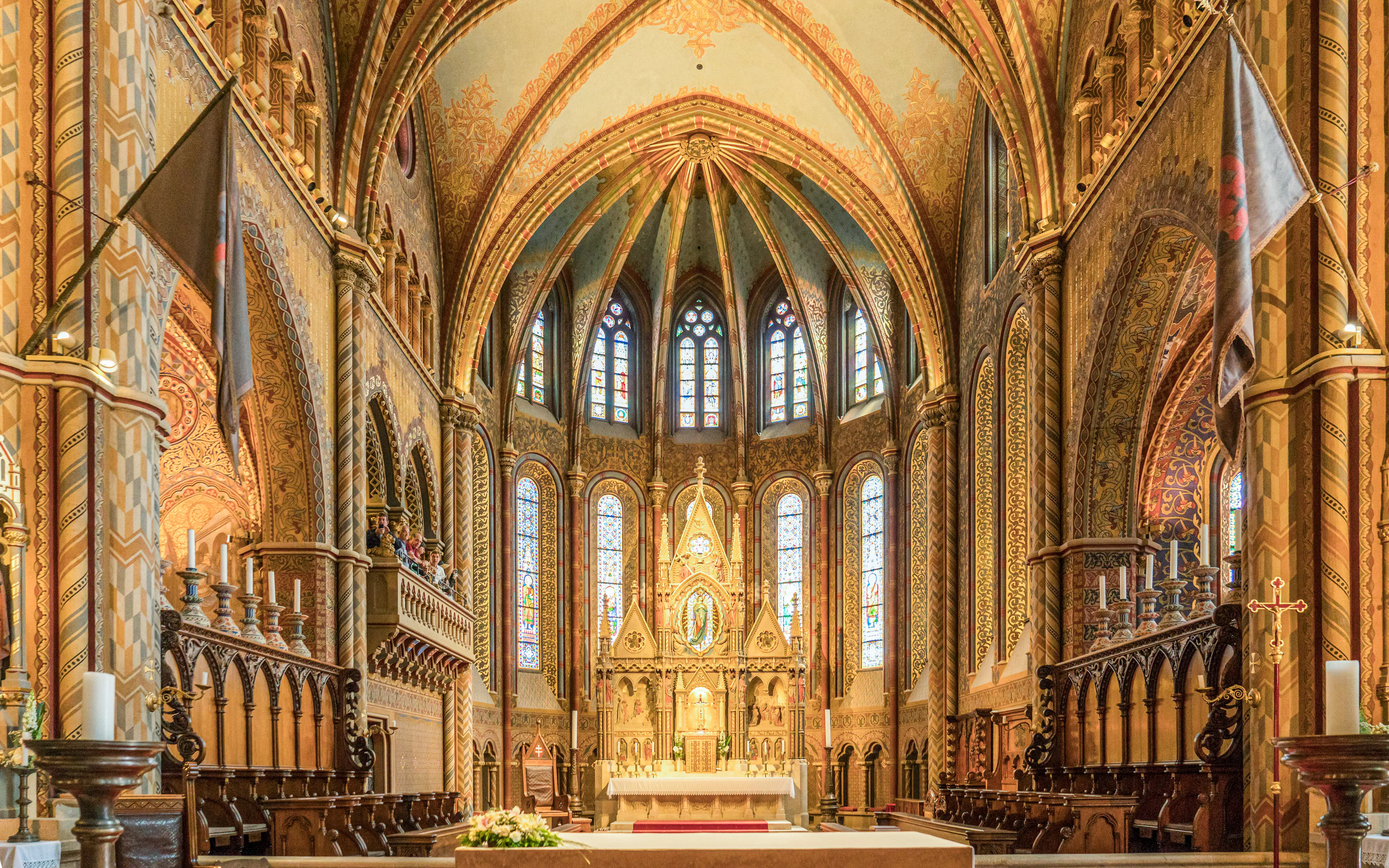
The main nave
This is where the church’s scale first lands. Stand still for a minute before moving on. The patterned walls, arches, and painted surfaces work best when you take in the whole room at once.
Painted walls and vaults
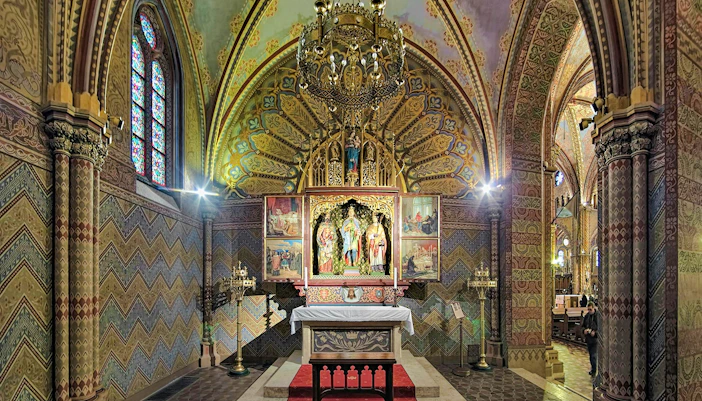
Matthias Church’s real signature is overhead and around you, not in one single masterpiece. Look up at the dense decorative program as this is what makes the interior feel so different from plainer European church visits.
Stained-glass windows
The stained glass adds color and softness to the interior, especially when daylight is strong. If you move slowly along the nave, you’ll notice how the light changes the mood from one section to the next.
Side chapels and sacred artworks
Don’t rush past the smaller devotional spaces. They give the visit its quieter texture and make the church feel lived-in rather than staged purely for tourism, even when the main nave is busy.
The King’s Organ
The organ adds another layer to the church’s ceremonial feel. Even when silent, it anchors the space visually and reminds you that this is still an active church, not just a preserved monument.
The tower terrace
This is a separate timed experience, not part of standard church entry. If you book it, expect 197 steps and a more physical visit. The reward is a rooftop panorama over the Castle District and Budapest beyond.
How to explore Matthias Church
How much time to spend?
Budget 45–60 minutes for the church itself, or up to 90 minutes if you like to linger over stained glass, side chapels, and painted details. Add roughly 30 minutes more if you’ve booked the tower, since it runs on a separate timed ticket.
Best visit order
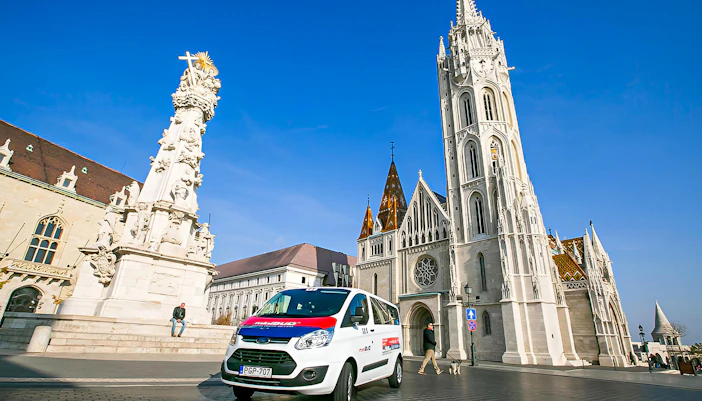
Start in Holy Trinity Square and take in the exterior first, especially the roof and tower silhouette. Then enter the church and move through the main nave before slowing down for the stained glass, side chapels, and decorative surfaces. Leave the tower for last so the climb feels like an upgrade, not a distraction.
Must-see highlights
Don’t miss the painted nave, stained-glass windows, decorative wall patterns, and the view up into the vaulting. The optional tower climb adds about 30 minutes and turns the visit from an interior stop into a viewpoint experience.
Worth adding nearby
Fisherman’s Bastion is steps away and pairs naturally with the church in another 20–40 minutes. If you’re continuing through Castle Hill, add the wider Buda Castle area and turn the visit into a compact half-day route.
Guided or self-paced?
Self-paced is the better default here because the church is compact and visually easy to enjoy on your own. Guided is worth it if you want the Castle District explained as a whole, especially the royal and coronation context that is not obvious from the interior alone. If you mainly want to browse, photograph details, and keep your day flexible, self-paced works well.
Brief history of Matthias Church
- Mid-13th century: King Béla IV founds the church after the Mongol invasion, making it one of medieval Buda’s defining religious buildings.
- 1384: The south-west tower collapses during mass, a dramatic turning point in the church’s architectural story.
- 15th century: Under King Matthias Corvinus, the church is rebuilt and strengthened its royal associations, which gave rise to its popular modern name.
- 1541–1686: During Ottoman rule in Buda, the church functions as a mosque rather than a Catholic church.
- 19th century: Architect Frigyes Schulek restores the building in a richly decorative Gothic Revival style that shapes much of what visitors see today.
- Today: Matthias Church remains an active Catholic church and one of the Castle District’s most important historic interiors.
Architecture of Matthias Church
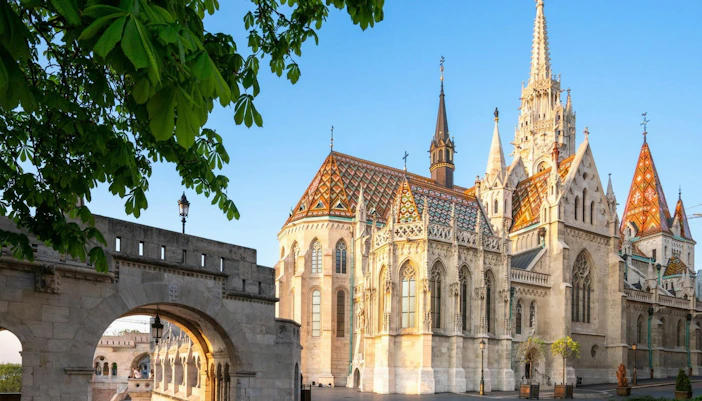
Matthias Church works by contrast. From the square, you notice the steep roof, tall tower, and compact silhouette against the Castle District skyline. Inside, the effect flips: instead of bare stone severity, you get a dense field of color, painted pattern, and stained glass that pulls your eye across every surface. The church began as a Gothic building, but its current personality comes largely from a 19th-century Gothic Revival restoration. What matters as a visitor is not the label, but the way the decoration slows you down. Look up into the vaulting, then back across the nave; the painted surfaces make the room feel ceremonial without feeling heavy. It is one of those interiors where texture, not scale, does the work.
Who built it?
Matthias Church began under King Béla IV as part of medieval Buda’s rebuilding. What most visitors experience today, though, owes much to architect Frigyes Schulek, whose 19th-century restoration reshaped the church in a vividly decorative Gothic Revival style and tied it visually to the surrounding Castle District.
Why Matthias Church feels tied to Hungarian state history
Matthias Church is more than a beautiful stop in the Castle District because it sits close to the center of Hungarian royal memory. This was the ceremonial church of Buda, tied to coronations, dynastic symbolism, and the public staging of power as much as private devotion. That is why the building can feel unusually formal even on a short visit. You are not just walking through a parish church with good decoration as you are standing in a space where monarchy, religion, and national identity repeatedly overlapped in full view of the city.
Frequently asked questions about Matthias Church
No. Matthias Church standard entry is single-entry only, so once you leave you cannot re-enter. If you want exterior photos and a full interior visit, do your square and Bastion views first, then enter the church last.
Yes. The audio guide runs on your own charged smartphone through on-site activation, and the church provides free Wi‑Fi. It is a good middle ground if you want context without joining a guided group.
Sometimes, yes for worship rather than tourism. Mass access and tourist entry follow different rules, so do not assume a sightseeing visit is free outside service times just because the building is an active church.
You may lose it. Matthias Church Tower access is tied to a selected date and time, and late arrivals are not typically moved to a new slot. Aim to reach the tower entrance at least 5 minutes early.
Yes. Strong wind, storms, or lightning risk can affect tower operations because the climb ends at an exposed terrace. If the Matthias Church Tower is your main reason for visiting, keep the rest of your schedule flexible.
Respectful dress is the main requirement. Shoulders and cleavage should be covered, and skirts or pants should reach the knees or lower. Think church-appropriate rather than elegant as the rule is about etiquette, not dressing up. See everything you need to know about Matthias Church.
Not automatically. Casual visitor photography is different from filming or photography done specifically for shooting purposes, which requires advance permission and a signed agreement with the church before the visit. Plan your visit to Matthias Church.
No. The Matthias Church Tower is stair-only, with 197 steps and no elevator or washroom. If stairs are difficult for you, stick with the church interior and nearby Bastion viewpoints instead of forcing the climb.