Quick Information
RECOMMENDED DURATION
2 hours
TICKETS
From $30.61
NUMBER OF ENTRANCES
2
EXPECTED WAIT TIME - STANDARD
30-60 mins (Peak), 0-30 mins (Off Peak)
EXPECTED WAIT TIME - SKIP THE LINE
0-30 mins (Peak), 0-30 mins (Off Peak)
Did you know?
Vajdahunyad Castle was originally built in 1896 for Hungary’s Millennium Exhibition and later reconstructed in stone by 1908.
The castle’s design is a patchwork of famous Hungarian architectural landmarks, making it a living showcase of the nation’s heritage.
The museum’s star exhibit is the complete skeleton of Kincsem, the world’s most successful racehorse, undefeated in 54 races.
Why visit Vajdahunyad Castle?
Vajdahunyad Castle is one of Budapest's most unusual attractions, and one of its most underrated. It looks, convincingly, like a medieval castle that has stood for centuries. It was actually built in 1896 as a temporary exhibition structure and has never been a royal or noble residence. That contrast is part of what makes it interesting.
The castle serves several purposes at once. As a piece of architecture, it is a deliberate survey of Hungarian building history across four styles and eight centuries, compressed into a single lakeside complex. As a museum, it holds one of Europe's most extensive collections of agricultural and rural history, covering everything from Neolithic farming tools to 20th-century machinery. As a public space, its courtyards, lake, and grounds are free to enter and used year-round: boating in summer, ice skating in winter, and festivals throughout the year.
For visitors to Budapest, the castle fits naturally into a City Park morning or afternoon alongside Heroes' Square and Széchenyi Thermal Bath, both within a 10-minute walk. For visitors with a particular interest in Hungarian history or architecture, the museum and tower views justify a dedicated visit. The courtyard alone, with its Anonymus statue, the Ják Chapel facade, and the hidden Dracula carving, rewards an unhurried hour even without buying a ticket.
History of Vajdahunyad Castle
Built to impress a nation 🎉
In 1896, Budapest was celebrating something big: 1,000 years of Hungarian history. For the Millennial Exhibition in City Park, architect Ignác Alpár was asked to do something ambitious, tell that entire story through a single building.
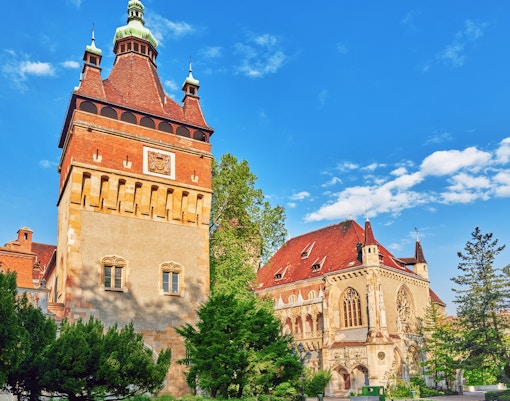
His answer was Vajdahunyad Castle. Instead of choosing one style, he blended four: Romanesque, Gothic, Renaissance, and Baroque. Each section mirrors a real Hungarian landmark. The Gothic wing, inspired by Hunyadi Castle in Transylvania, gave the complex its name.
There’s a twist, though: this “castle” wasn’t meant to last. It was built quickly using wood and plaster, just for the exhibition. But visitors loved it so much that tearing it down didn’t feel like an option.
From temporary to timeless 🏗️
By 1899, the original structure had started to fall apart and was demolished. But by then, public opinion had already decided—this building needed to stay.
So, it was rebuilt in stone between 1904 and 1908, with Alpár refining his design for permanence. The reopening was led by Emperor Franz Joseph I, marking its transition from exhibition piece to lasting landmark.
The castle didn’t escape history unscathed. It was damaged during World War II and again in the 1956 uprising, but careful restoration brought it back to life.
Inside: The Hungarian Agricultural Museum 🌾
From the start, the castle wasn’t just about architecture, it housed the Hungarian Agricultural Museum, founded in 1896.
Today, it’s one of Europe’s largest of its kind, covering farming and livestock, wine-making, forestry and fishing, and food production. You’ll move from prehistoric tools to industrial machines, with interactive exhibits along the way.
A champion that never lost 🐎
One exhibit always draws a crowd: Kincsem, Hungary’s legendary racehorse. She raced between 1876 and 1879, and won all 54 races she entered. No other horse has matched that record. Her skeleton is displayed in the Baroque wing, a quiet but powerful reminder of Hungary’s rural roots and sporting history.
Architecture of Vajdahunyad Castle
Vajdahunyad Castle is a walk through Hungarian architectural history. Architect Ignác Alpár designed it as a visual timeline, dividing the complex into four sections. As you walk around the castle, you move through eight centuries of design in under an hour—each turn feels like stepping into a different era.
Romanesque (11th–13th century) 🪨
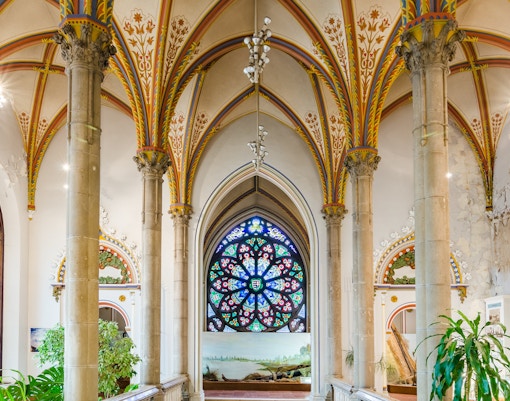
This section is anchored by the Ják Chapel portal, one of the most detailed parts of the complex. It’s a replica of the 13th-century Church of Saint George in Ják, complete with carved stone columns, sculpted figures, and heavy, rounded arches. Step inside the chapel, and the atmosphere shifts, quiet, solid, and grounded, just like early medieval architecture.
Gothic (14th–15th century) 🏰
This is where the castle truly earns its name. Inspired by Corvin Castle in Transylvania, the Gothic wing brings in tall towers and battlements, the Apostles’ Tower (the highest point), and a vaulted Knights’ Hall inside. It’s dramatic and defensive: built to impress, but also to intimidate.
Renaissance (15th–16th century) 🎭
The mood softens here. Inspired by the palace of King Matthias Corvinus at Visegrád, this section reflects a time when Hungary looked to Italy for artistic influence. Look for an elegant loggia with arched colonnades, open, balanced spaces, and a lighter, more refined feel
Baroque (17th–18th century) 🏛️
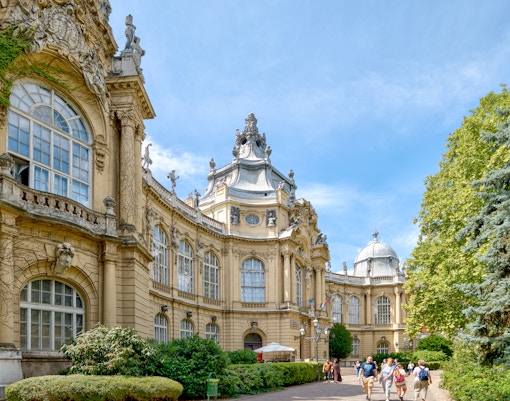
The final section is the largest, and the one you’ll likely spend the most time in. Modelled after the palace of Prince Paul Esterházy I, the Baroque wing now houses the Hungarian Agricultural Museum. Inside, expect long gallery corridors, high ceilings, and softer lighting that suits exhibitions.
City Park highlights nearby
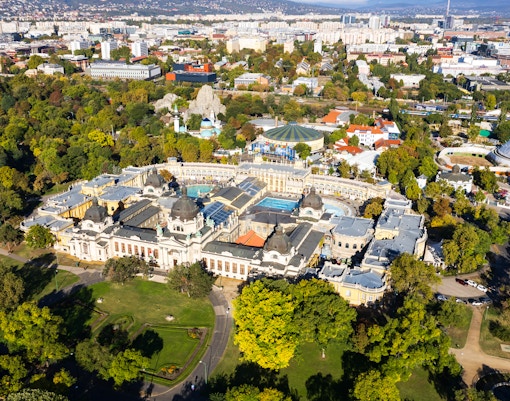
Vajdahunyad Castle sits at the centre of Budapest's City Park (Városliget), one of the city's main green spaces and one of the most concentrated areas for Budapest attractions. The following landmarks are all within easy walking distance:
- Heroes' Square (Hősök tere): 5 minutes on foot. The Millennium Monument at the centre of Heroes' Square is Budapest's largest single monument, featuring the Seven Chieftains of the Magyar tribes and fourteen Hungarian kings and leaders. Entry to the square is free.
- Széchenyi Thermal Bath: 10 minutes on foot. One of the largest thermal bath complexes in Europe, with 18 pools fed by natural geothermal springs. One of Budapest's most popular City Park highlights and bookable in advance.
- Museum of Fine Arts: 8 minutes on foot. Hungary's primary collection of European fine art, including works from Egyptian antiquity to the 20th century. Located directly on Heroes' Square.
- Budapest Zoo and Botanical Garden: 10 minutes on foot. One of the oldest zoos in the world, established in 1866, set within City Park.
- House of Music Hungary: 8 minutes on foot. A contemporary concert and exhibition venue dedicated to Hungarian music history, designed by Japanese architect Sou Fujimoto. Opened in 2022.
Frequently asked questions about Vajdahunyad Castle
The castle courtyard is free to enter at any time, except during ticketed festivals. Museum exhibits and tower climbs require a purchased ticket.
The standard museum ticket including the Gatehouse Tower costs from €9. The upgraded option adding the guided Apostles' Tower tour costs from €12. On-site tickets are priced in Hungarian forints (approximately HUF 2,500 for adults for the standard museum ticket). Children under 6 enter free; reduced fares for students and seniors are available on-site only.
Yes. Pre-booking online lets you skip the 15–30 minute ticket booth queue on busy days. Free and reduced-price tickets must be purchased on-site.
Tuesday to Sunday, 10am to 5pm (10am to 4pm November to February). Closed on Mondays. Last museum entry is at 4:30pm. The Gatehouse Tower is open daily 9am to 7pm.
The courtyard and museum ground floor are wheelchair accessible. Both tower climbs involve stairs only and are not suitable for wheelchair users.
Weekday mornings at opening time (10am) for the quietest experience. Late spring (April to June) and early autumn (September to October) for mild weather and lighter crowds. Winter (November to March) if you want to combine the castle visit with the outdoor ice rink.
The Kincsem skeleton in the Baroque wing, the Apostles' Tower panoramic view, the Anonymus statue in the courtyard, the Ják Chapel portal, and the Dracula carving in the castle wall.
Kincsem was Hungary's undefeated racehorse, winning all 54 of her races between 1876 and 1879. Her preserved skeleton is on permanent display in the Baroque wing of the Hungarian Agricultural Museum; it is one of the most distinctive exhibits in any Budapest attraction and draws consistent interest from visitors.
Vajdahunyad Castle itself is not a designated UNESCO property, but it sits within Budapest's City Park, and the broader Budapest cityscape, including the Danube banks, Buda Castle quarter, and Andrássy Avenue, is listed as a UNESCO World Heritage Site.