Visiting St. Stephen’s Basilica: your guide
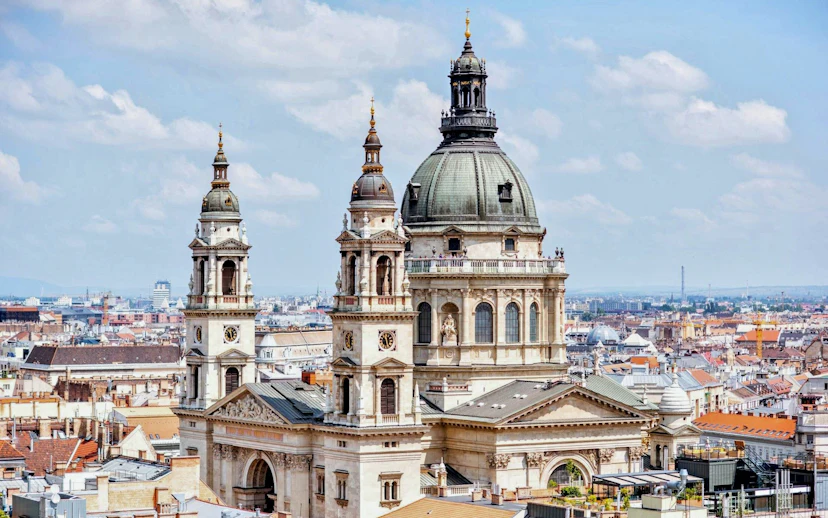
St. Stephen’s Basilica is Budapest’s great neo-Classical church, best known for its 96m dome, sweeping city views, and the Holy Right relic of Hungary’s first king. The visit itself is fairly manageable, but it rewards good sequencing more than people expect: if you want the terrace, treasury, and quiet time inside the nave, arriving at the right hour matters. The biggest mistake is treating it like a quick photo stop. This guide covers timing, entrances, tickets, and how to plan the visit well.
Quick overview: St. Stephen’s Basilica at a glance
If you want the full experience here, plan for more than just a look inside the church.
- When to visit: Monday–Saturday visitor hours usually run 9am–5:45pm, with the panorama terrace and treasury open until 7pm; weekday mornings are noticeably calmer than 11am–3pm, when tour groups, dome visitors, and lift queues overlap.
- Getting in: From about $7 for basilica entry. Dome and treasury access from about $10–$11. Booking ahead matters most on summer weekends, holiday periods, and Mondays if you want the terrace or organ concert without waiting.
- How long to allow: 45–90 minutes for most visitors. It stretches toward the longer end if you add the treasury, terrace, and time to sit through the Monday organ recital.
- What most people miss: The Holy Right relic in the treasury, the mosaic and fresco details above the nave, and how good the terrace is as an orientation stop before the rest of central Budapest.
- Is a guide worth it? Yes, if you want the history of St. Stephen, the symbolism of the dome, and the art explained properly; if you mainly want the terrace and interior, a self-guided visit with the pamphlet is usually enough.
🎟️ Dome tickets for St. Stephen’s Basilica can sell out 2–3 days in advance during summer weekends and December. Lock in your visit before the time you want is gone. See ticket options
Jump to what you need
🕒 Where and when to go
🗓️ How much time do you need?
🎟️ Which ticket is right for you?
🗺️ Getting around
⛪ What to see
♿ Facilities and accessibility
Where and when to go
How do you get to St. Stephen’s Basilica?
St. Stephen’s Basilica is in central Pest, just north of Deák Ferenc tér and a short walk from Arany János utca station.
Szent István tér 1, 1051 Budapest, Hungary
- Metro: Arany János utca (M3) → 2-minute walk → easiest stop if you want the side ticket office and dome access first.
- Metro: Deák Ferenc tér (M1, M2, M3) → 8–10-minute walk → best if you’re combining the basilica with downtown Budapest sightseeing.
- Tram/Bus: Deák Ferenc tér stops → 8–10-minute walk → useful if you’re arriving from the Danube or Parliament area.
- Taxi/rideshare: Drop-off at Szent István tér → 1–2-minute walk → simplest option for evening concerts or Sunday services.
Which entrance should you use?
The setup is simple once you know it, but many visitors lose time by joining the wrong line or heading straight to the dome without sorting tickets first.
- Main church entrance: Located on Szent István tér at the front façade. Best for general basilica entry and timed sightseeing access. Expect 5–15 minutes’ wait on weekday mornings.
- Side ticket office / dome access: Located to the right-hand side of the basilica. Best for panorama terrace and treasury visitors. Expect 10–25 minutes’ wait from late morning into mid-afternoon.
When is St. Stephen’s Basilica open?
- Monday–Saturday: Basilica visitor hours usually run 9am–5:45pm.
- Sunday: Visitor access usually starts after 1pm, and services or ceremonies can further affect entry.
- Monday–Sunday: Panorama terrace and treasury usually run 9am–7pm.
- Last entry: For the smoothest full visit, arrive by 5pm if you want the church, terrace, and treasury without rushing.
When is it busiest? Late morning to mid-afternoon, especially Friday–Sunday from May through September and in December, when the ticket office, lift area, and terrace all back up at once.
When should you actually go? Weekday opening hour is the easiest window because the nave is quieter, the light is better for interior detail, and the lift queue usually hasn’t formed yet.
How much time do you need?
| Visit type | Route | Duration | Walking distance | What you get |
|---|---|---|---|---|
Highlights only | Main entrance → nave → main altar → side chapels → exit | 30–45 min | ~0.3km | You see the architecture, mosaics, and main worship space, but you skip the Holy Right relic, the terrace, and the best city views. |
Balanced visit | Main entrance → nave → treasury/Holy Right relic → dome terrace → exit | 60–75 min | ~0.6km | This adds the relic and panorama terrace, which is the version most visitors find worth the ticket, but it still keeps the pace fairly brisk. |
Full exploration | Main entrance → nave and side details → treasury → dome terrace → quiet time inside or Monday organ recital → exit | 1.5–2 hr | ~0.8km | This gives you the most complete sense of the basilica as both a church and sightseeing stop, but it only works well if you’re willing to plan around services, concerts, and lift waits. |
Which St. Stephen’s Basilica ticket is best for you
| Ticket type | What's included | Best for | Price range |
|---|---|---|---|
Basilica Entry | Basilica interior + multilingual pamphlet | A short stop where you want to see the church properly without paying extra for the terrace or treasury. | From $7 |
Panorama Terrace and Treasury ticket | Basilica entry + panorama terrace + treasury + Holy Right relic | A visit where you don’t want to leave feeling you skipped the most distinctive parts of the site. | From $10 |
Guided basilica tour | Entry + guide + route through the church and key highlights | A first visit where you want the story behind the art, relic, and national symbolism rather than just the visuals. | From $25 |
Organ concert ticket | Entry + reserved concert seating + organ recital access | A visit built around the acoustics and atmosphere, especially if you want the basilica to feel like more than a sightseeing stop. | From $5–$7 locally |
Basilica + Danube cruise combo | Basilica visit + Danube cruise | A same-day plan where you want one indoor landmark and one broad city view without building the itinerary from scratch. | From $65 |
How do you get around St. Stephen’s Basilica?
How is St. Stephen’s Basilica laid out?
The basilica is best explored on foot and is easy to cover in under 90 minutes, though the terrace and treasury add a second layer to the visit.
The main focal point is straight ahead from the front entrance — the nave leads you visually toward the altar, while the treasury and dome route sit off to the side rather than naturally in your path.
- Main nave → the grand interior, frescoes, and pews → budget 15–20 minutes.
- Main altar area → gold-toned decoration and the visual center of the church → budget 5–10 minutes.
- Treasury / Holy Right relic → the basilica’s most historically specific section → budget 10–15 minutes.
- Dome terrace → open-air city panorama around the drum of the dome → budget 20–30 minutes.
Suggested route: See the nave first while it’s still quiet, then move to the treasury for the Holy Right relic, and leave the terrace for last so you finish with the view rather than backtracking through the church.
Maps and navigation tools
- Map: Printed pamphlets are available at the entrance → they cover the church and main visitor points → pick one up before you walk into the nave.
- Signage: Wayfinding is decent once you’re inside, but the treasury and dome access are easier if you identify the side entrance before joining any line.
- Audio guide / app: Audioguide options are available through some ticket types → useful for history and symbolism → it adds more value than a fully self-guided visit if you care about the relic and art.
💡 Pro tip: Do the terrace last — if you head for the lift first, you’ll often spend your freshest part of the visit standing in the smallest queue area.
Get the St. Stephen’s Basilica map / audio guide
What are the most significant spaces in St. Stephen’s Basilica?

The dome terrace
Attribute — Era: 20th-century completed dome and modern visitor terrace access
This is the part of the visit that changes the basilica from a church stop into a city-view attraction. From here, you get one of Budapest’s clearest 360° panoramas, including the Parliament building, Buda Castle, and the Danube corridor. Most visitors rush the photos and leave, but it’s worth pausing long enough to orient yourself to the rest of the city.
Where to find it: Access it from the side ticket and lift area on the right-hand side of the basilica.
The Holy Right relic
Attribute — Relic: Mummified right hand of King Stephen I
This is the most specific and nationally important object in the building, and it gives the basilica its strongest link to Hungarian statehood rather than just church history. Because it sits in the treasury and the lighting is low, plenty of visitors miss it entirely or move past too quickly to understand what they’re seeing.
Where to find it: In the treasury section included with the combined ticket, off the main visitor route.
The main nave
Attribute — Era: Neo-Classical interior with 19th-century decoration
The nave is where the basilica feels largest, with marble, gilded detailing, and a long sightline that builds toward the altar. What most people miss is that the impact comes as much from looking up as looking ahead — the frescoes, vaulting, and scale read best from the center rather than the entrance threshold.
Where to find it: Straight ahead from the main front entrance on Szent István tér.
The dome frescoes
Attribute — Artist: Károly Lotz
These are among the interior details people photograph least well and remember most strongly in person. The fresco work high above the nave pulls your eye upward and helps explain why the space feels so theatrical despite the church’s restrained exterior. Most visitors don’t stop far enough back to take in the full composition.
Where to find it: Look up from the center crossing beneath the dome, not from the front doors.
The main altar and mosaic work
Attribute — Medium: Monumental religious mosaic and altar decoration
This is the visual anchor of the church interior, and it rewards a slower look once the large groups clear. People often focus on the scale and gold tones, but the better detail is how the mosaic and architectural frame pull the whole apse together rather than reading as a single object.
Where to find it: At the eastern end of the nave, directly opposite the main entrance.
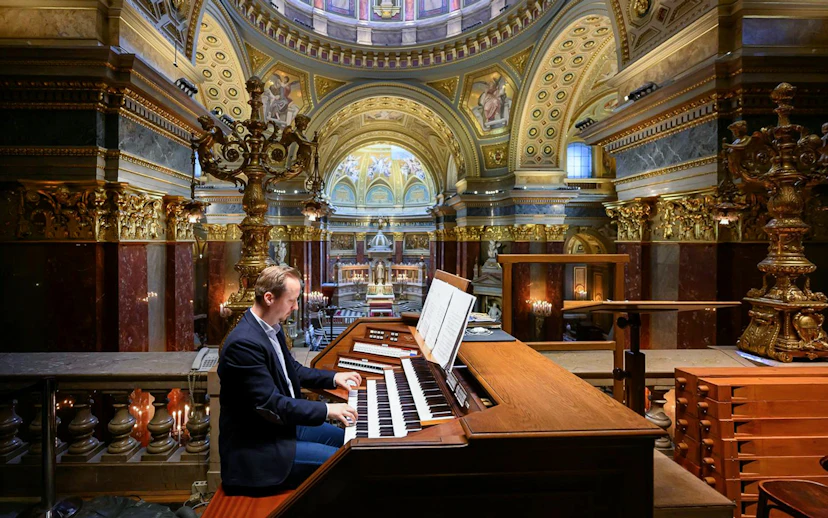
The grand organ
Attribute — Type: Concert organ with more than 6,000 pipes
The organ matters even when it isn’t being played because it helps explain why concerts here feel so memorable: the whole building was made to carry sound. If you visit on Monday, staying for the 4:30pm recital changes the mood of the space completely. Many visitors see the organ and move on without realizing they can hear it live.
Where to find it: In the main church interior, visible from the nave seating area.
Facilities and accessibility
- 🚻 Restrooms: Restrooms are available on the terrace level, which is useful if you’re doing the full church-and-dome visit in one go.
- 🛍️ Gift shop / merchandise: There is a small visitor retail area near the exit route, and it’s a better stop for postcards and religious souvenirs than the street stalls outside.
- 🪑 Seating / rest areas: The nave has pew seating throughout, so this is one of the easier central Budapest landmarks to pace slowly.
- 📖 Visitor materials: Multilingual pamphlets are available at the entrance, and they help more than most people expect if you’re visiting without a guide.
- ♿ Mobility: The main church floor is the easiest part to access, and the dome route has an elevator, but the lift only takes 4 people at a time and can become the least comfortable part of the visit.
- 👁️ Visual impairments: Printed visitor materials are available at the entrance, but the experience is still highly visual and the treasury lighting around the Holy Right relic is intentionally low.
- 🧠 Cognitive and sensory needs: Weekday mornings are usually the calmest window, while the lift area, concert times, and Sunday service periods are the most intense for crowding and sound.
- 👨👩👧 Families and strollers: The nave is manageable with a stroller, but the full route is easier with a compact stroller or carrier because the dome queue area is tight.
This works well for school-age children because the visit is short, the dome gives them a clear payoff, and the relic and organ make it feel more varied than a church-only stop.
- 🕐 Time: 45–60 minutes is realistic with children if you focus on the nave, relic, and terrace rather than every side detail.
- 🏠 Facilities: Pew seating and terrace-level restrooms make this easier than many historic churches in central Europe.
- 💡 Engagement: Let children spot Budapest landmarks from the terrace — Parliament and the Danube are easy wins that make the climb or lift queue feel worthwhile.
- 🎒 Logistics: Bring a light layer and a compact bag, and aim for opening hour so you’re not doing the lift queue at the busiest point of the day.
- 📍 After your visit: The square outside is lined with cafés and open space, so it’s an easy reset before walking toward the Danube.
Rules and restrictions
What you need to know before you go
- Entry requirement: You’ll need a valid timed or same-day ticket, and reduced-price tickets are usually checked against ID at the ticket office.
- Bag policy: Bags go through security screening, so a small day bag is quicker and easier than arriving with bulky luggage.
- Re-entry policy: Tickets are single-entry, which means once you leave for coffee or a break outside, you can’t just walk back in and pick up where you left off.
Not allowed
- 🚫 Food and drink: Eating and drinking aren’t part of the visit inside the church, so plan coffee or meals for before or after you enter.
- 🚬 Smoking/vaping: Smoking and vaping belong outside the basilica precinct, not in the church or visitor areas.
- 🖐️ Touching exhibits: Don’t touch altars, relic displays, or decorative surfaces, because this is still an active religious space as well as a monument.
Photography
- Casual photography is generally fine during normal visitor hours, but this is not a free-for-all photo space.
- Be respectful around worshippers, services, and concerts, and expect staff to intervene if your setup becomes intrusive.
- Flash is best avoided in the interior, and tripods or other bulky equipment are not a good fit for the nave, treasury, or dome queue.
Dress code
St. Stephen’s Basilica enforces a dress code for entry to the church. Entry can be refused if the requirements below are not met.
Required:
- Shoulders covered
- Knees covered
- No beachwear or overly revealing clothing
Good to know: If you arrive underprepared, the easiest fix is the one you bring with you — a light scarf or extra layer works faster than trying to solve it at the door.
⚠️ Dress code is enforced at the entrance with no exceptions. Shorts and strappy tops are the most common reasons people get delayed or turned away, and a scarf is the easiest fix for both men and women.
Good to know
- Sunday access before 1pm is often limited by services, so don’t plan a sightseeing visit for early Sunday unless you’ve checked the day’s schedule.
- Monday at 4:30pm is a smart exception to the usual sightseeing rhythm because the organ recital adds real value without turning the visit into a full evening event.
Practical tips
- Book the terrace-and-treasury ticket, not just church entry, if this is your only visit — the Holy Right relic and skyline view are what make this stop feel distinctly Budapest rather than just another large church.
- In May through September, and again in December, book at least 2–3 days ahead if you want a specific day and time for the dome; the interior is easier to get into than the terrace route.
- If you’re late for a timed visit, don’t assume the staff will simply wave you through — at busy hours, late arrival usually means joining the slower same-day flow rather than walking straight in.
- Start inside the nave, then do the treasury, then finish on the terrace; doing the lift first means spending your most patient minutes in the tightest part of the building.
- Save a little energy for the terrace even if the church feels like the main event — the payoff is only 20–30 minutes, but it’s the part most people talk about afterward.
- Weekday opening hour works best here not just because it’s quieter, but because the dome lift queue hasn’t yet stacked up and the nave still feels like a church instead of a tour stop.
- Bring a layer or scarf even in summer; it solves the dress code issue and helps if you linger on the windy terrace.
- Don’t plan food in the middle of the visit, because tickets are single-entry and the better option is to eat on Szent István Square right after you finish.
What else is worth visiting nearby?
Commonly paired: Hungarian Parliament Building
Hungarian Parliament Building
Distance: 1km — 12-minute walk
Why people combine them: They tell two sides of the same Budapest story — church and state — and the matching 96m heights make the pairing feel more connected than it first appears.
Book / Learn more
Commonly paired: Danube cruise docks
Danube cruise docks
Distance: 700m — 8–10-minute walk
Why people combine them: The basilica gives you the skyline from above, while the river gives you the same city from water level, which makes for an easy same-day Budapest views itinerary.
Book / Learn more
Also nearby
Hungarian State Opera House
Distance: 850m — 10-minute walk
Worth knowing: It’s an easy add-on if you want another grand interior nearby, and the route there takes you through one of central Pest’s easiest walking stretches.
Dohány Street Synagogue
Distance: 1.2km — 15-minute walk
Worth knowing: It’s one of the most important Jewish heritage sites in Europe, and pairing it with the basilica gives you a broader view of Budapest’s religious history in a single afternoon.
Eat, shop and stay near St. Stephen’s Basilica
- On-site: There isn’t a full sit-down café inside the basilica, so most people eat before entering or head straight to the restaurants on Szent István Square after the visit.
- Gelarto Rosa (1-minute walk, Szent István tér 3): Rose-shaped gelato, moderate prices, and the quickest post-visit stop if you want something light without losing time.
- DiVino Budapest (1-minute walk, Szent István tér 3): Wine bar with terrace seating, moderate prices, and a strong option if you want to sit facing the basilica after sunset.
- Hummusbar (4-minute walk, Október 6. utca 19): Fast Middle Eastern plates at budget-to-moderate prices, useful when you want a proper meal without a formal booking.
- Pro tip: Eat after, not before, if you’re visiting around 4:30pm on Monday — you’ll get more out of the organ recital, and the square is easier for an early dinner than the lift queue is on a full stomach.
- Basilica gift shop: Religious souvenirs, postcards, and small keepsakes, located on the visitor exit route and more reliable than the kiosks outside.
- Fashion Street: Mainstream shopping and easy browsing a short walk away toward Deák Ferenc tér, useful if the basilica is just one stop in a central Budapest afternoon.
Yes, if you’re on a short Budapest trip and want to walk to major central sights without thinking too hard about transit. Around the basilica and Deák Ferenc tér, you’re close to the river, Parliament, the Opera, and plenty of dining. It’s less ideal if you want a quieter, more local neighborhood feel at night.
- Price point: This area skews mid-range to high, with the best value usually just a few blocks back from the square rather than directly on it.
- Best for: Short stays, first-time Budapest visitors, and travelers who want to cover a lot on foot from one central base.
- Consider instead: Castle District for a quieter, more atmospheric stay, or Erzsébetváros if food, nightlife, and lower accommodation prices matter more than being right by the basilica.
Frequently asked questions about visiting St. Stephen’s Basilica
Most visits take 45–90 minutes. If you only want the church interior, 30–45 minutes is enough, but adding the treasury, Holy Right relic, and dome terrace pushes the visit closer to 1–1.5 hours. Monday organ recitals can extend it to around 2 hours.
Yes, it’s smart to book ahead if you want the dome terrace or you’re visiting in summer, on weekends, or in December. The basilica interior is easier to access than the terrace route, but dome tickets can sell out or come with longer waits once late-morning crowds build.
Yes, Skip the line is worth it on busy days, especially if you want the terrace and don’t want to spend part of a short visit in the ticket queue. The value is less dramatic on quiet weekday mornings, when the basilica is manageable and the bigger bottleneck is usually the small-capacity lift.
Arrive 15–20 minutes early for a standard visit, and a little earlier if you’re heading to the dome or a Monday recital. That gives you time for security, ticket checks, and finding the correct entrance without turning the start of the visit into a rush.
Yes, but small bags are much easier than large ones. Bags go through security screening, and bulky luggage slows you down at exactly the point where the queues are already tightest. If you’re planning a central Budapest walking day, pack light before you come here.
Yes, casual photos are generally fine during normal visitor hours. Just keep it respectful, avoid intrusive setups, and expect tighter rules during services or concerts. Flash and large equipment are a poor fit here even when they’re not explicitly stopped.
Yes, but groups need to time the visit carefully because the basilica feels much more crowded once several tours overlap. If you’re coming as a group, weekday mornings are the easiest window, and the dome lift becomes the main pinch point because it only takes 4 passengers at a time.
Yes, it’s one of the easier central Budapest landmarks to do with children because the route is short and the terrace gives the visit a clear payoff. Most families do well in 45–60 minutes, especially if they keep the focus on the main church, the relic, and the city view.
Partly, yes — the main church is the easiest accessible section, and there is an elevator to the dome route. The main limitation is crowding rather than distance, because the lift is very small and the terrace area can feel tight when several visitors are waiting at once.
Food is easy to find nearby, but not inside the basilica in any meaningful sit-down way. Szent István Square and the surrounding blocks have plenty of cafés, wine bars, and quick lunch spots, so it makes more sense to eat right after your visit than try to build it into the middle.
Yes, you should cover your shoulders and knees to avoid problems at the entrance. This is still an active church, not just a tourist attraction, and visitors in shorts, beachwear, or strappy tops are the ones most likely to get delayed or refused entry.